
Best eBay Alternatives in the UK: How to Sell Online Without Paying High Fees
Selling on eBay UK is no longer as profitable as it once was—especially for small businesses. Between listing fees, final value fees, and constant competition, margins are steadily being reduced.
While private sellers in the UK may benefit from reduced or zero final value fees in some categories, business sellers—who make up the majority of professional online sellers—are still typically charged percentage-based fees on each transaction, along with fixed and operational costs.
For many UK sellers, the question is no longer how to sell online, but how to sell without losing a significant share of every transaction to platform fees.
This shift is why more sellers are now actively moving towards lower-cost, more flexible alternatives.
Why Sellers Are Moving Away from eBay
The issue is structural: eBay’s model depends on charging business sellers a percentage of each sale.
Key limitations:
- Fees reduce profitability
A portion of each sale is taken, regardless of margin. - Pay-to-compete environment
Visibility often requires additional spend on promoted listings. - Restricted control
Sellers must operate within fixed rules on listings, delivery, and disputes. - Platform dependency risk
Reliance on a single marketplace means that account restrictions or policy enforcement actions can interrupt or suspend trading, sometimes with limited notice. For small businesses, this creates direct revenue risk.
What Sellers Actually Need Instead
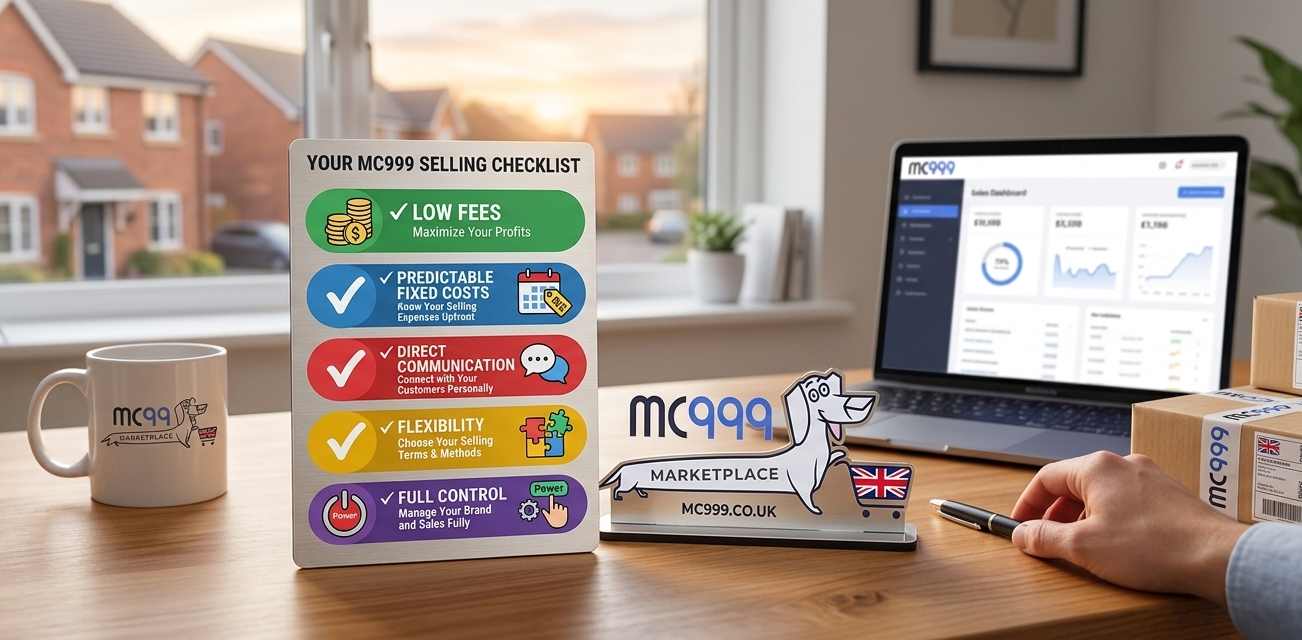
A strong alternative should address the core issues directly:
- No or minimal transaction fees
- Predictable, fixed costs
- Direct communication with buyers
- Flexible pricing models
- Control over how transactions are completed
The Strongest eBay Alternatives in the UK
1. MC999 Marketplace (Low Cost, High Control)
MC999 is structurally different from platforms such as eBay and Amazon.
Key advantages:
- No commission on sales
You keep what you earn—there is no percentage taken per transaction. - Subscription-based pricing
Fixed, predictable costs rather than variable fees. - Sell products and services
Including fixed-price, hourly, and negotiable pricing options. - Direct buyer communication
Built-in messaging plus external channels such as phone and WhatsApp. - Full control over transactions
Payments are handled off-platform, giving sellers complete flexibility. - Platform integrations
Connect with tools like Shopify, Shopline, and BigCommerce to manage inventory and operate across multiple sales channels.
Why this matters:
Instead of scaling costs as sales grow, MC999 allows businesses to scale volume while keeping platform expenses stable.
2. Amazon UK (Scale with Higher Costs)
Amazon offers reach and infrastructure, but at a higher overall cost.
Strengths:
- Large UK and international audience
- Fulfilment and logistics solutions
- Strong consumer trust
Limitations:
- Referral fees typically range from ~8–15%
- Total costs can exceed 30%+ when fulfilment, storage, and advertising are included
- Highly competitive environment

3. Etsy UK (Niche and Creative Products)
A platform tailored to handmade, vintage, and craft items.
Strengths:
- Targeted niche audience
- Simple onboarding
- Lower upfront listing costs
Limitations:
- Fees accumulate across transactions and payments
- Limited product categories
- Competitive within popular niches
4. Gumtree UK (Local, Low-Cost Selling)
A classifieds platform focused on local transactions.
Strengths:
- Low or free listings
- Local buyer base
- Minimal barriers to entry
Limitations:
- Limited buyer protection
- Less structured selling environment
- Reduced scalability
5. Facebook Marketplace (Fast, Informal Sales)
Part of Facebook, this is a quick-access selling channel.
Strengths:
- Free listings
- Direct local reach
- Built-in social trust
Limitations:
- Manual transaction handling
- Limited formal support
- Not ideal for structured or scalable businesses
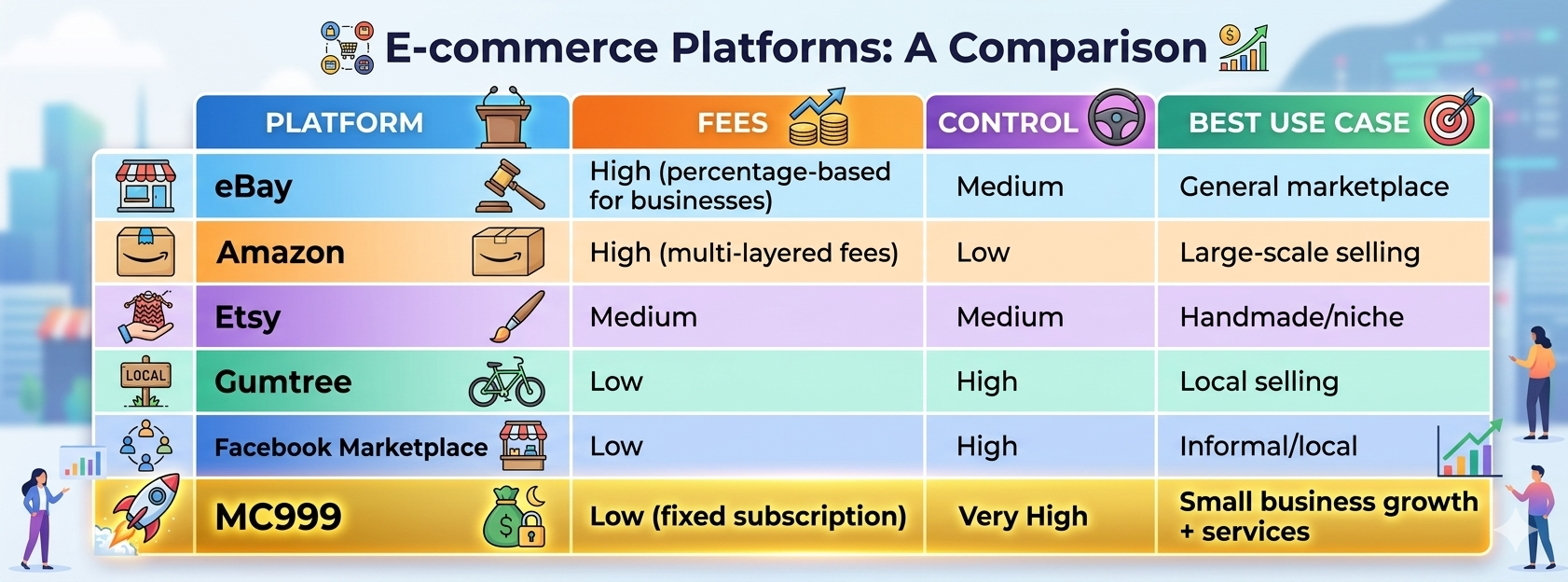
Quick Comparison: Fees vs Control
How to Increase Sales on Any Platform
- Optimise listings
Clear titles, detailed descriptions, high-quality images. - Price strategically
Balance competitiveness with sustainable margins. - Build trust
Reviews, responsiveness, and clear communication. - Use visibility tools selectively
Avoid overspending on paid exposure. - Leverage integrations
Tools like Shopify can streamline multi-channel operations.
The Real Decision: Fees vs Control
Most platforms force a trade-off:
- High reach → higher fees (e.g. Amazon)
- Low cost → less structure (e.g. Gumtree)
MC999 takes a different approach:
- Low, predictable cost
- High operational control
- Support for both products and services (including negotiable pricing)

Selling Online Without High Fees
Continuing to rely solely on eBay UK exposes sellers to both high fees and platform dependency risks.
Other platforms such as Etsy, Gumtree, and Facebook Marketplace each offer different advantages. However, they do not fully resolve both cost control and operational flexibility.
MC999 Marketplace stands apart by:
- Removing percentage-based commissions
- Supporting both product and service listings
- Enabling flexible pricing models, including negotiable pricing
- Offering integrations with tools such as Shopify, Shopline, and BigCommerce
For UK small businesses, this creates a more stable and scalable model.
If the goal is to increase sales while maintaining control over margins and operations, expanding beyond eBay is a practical and rational step.