
Start an Online T-Shirt Business in 2026: From Design to First Sale
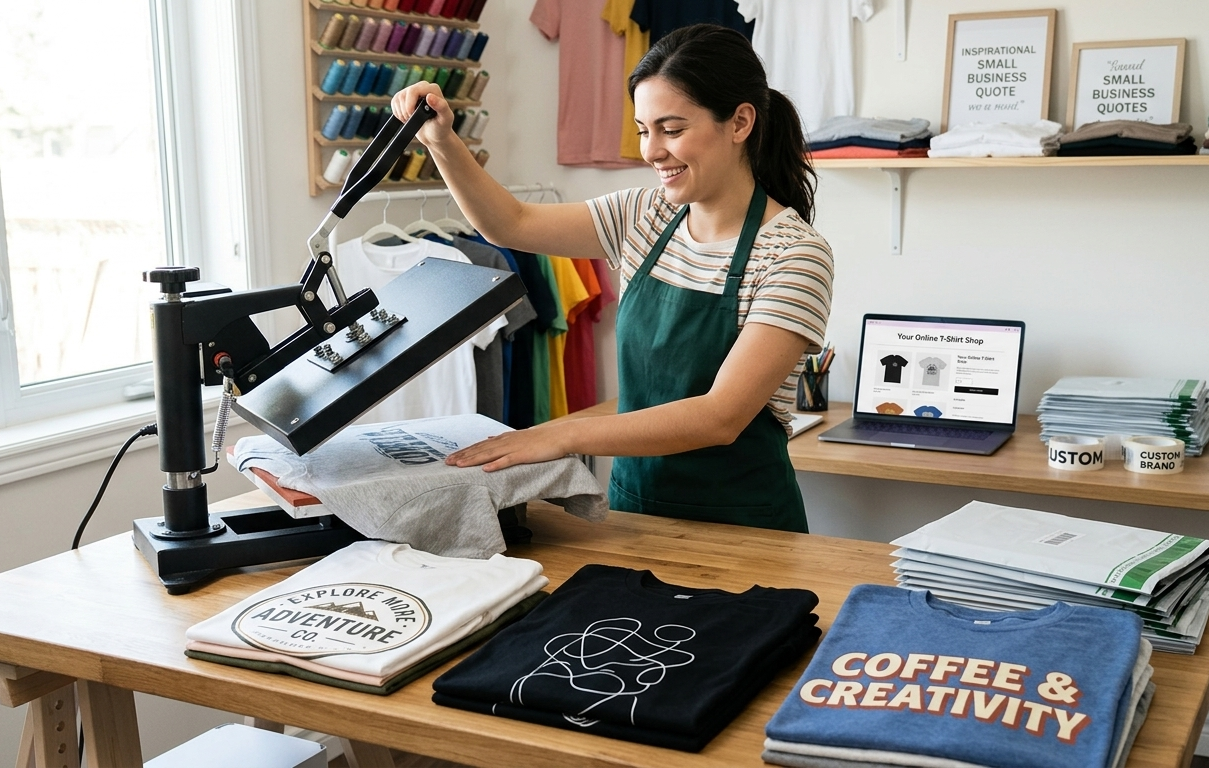
Launching an online t-shirt business in 2026 remains one of the most accessible entry points into ecommerce. The model has evolved: success now depends less on mass production and more on brand identity, niche positioning, and direct relationships with customers.
This guide outlines a structured, current approach—from niche selection to first sale—aligned with how modern apparel brands actually operate.
Why a T-Shirt Business Is Still Profitable in 2026
The global custom apparel market continues to expand, driven by ecommerce adoption, personalisation, and the creator economy. T-shirts remain a core product due to their universality, repeat purchase potential, and adaptability across audiences.
The key shift is strategic focus. Broad, generic designs rarely perform. Micro-niches—such as anime communities, gym culture, pet owners, or profession-based humour—consistently outperform generalised branding.
Well-positioned brands operating direct-to-consumer models can achieve margins in the 40–70% range, assuming disciplined pricing, efficient fulfilment, and effective marketing.
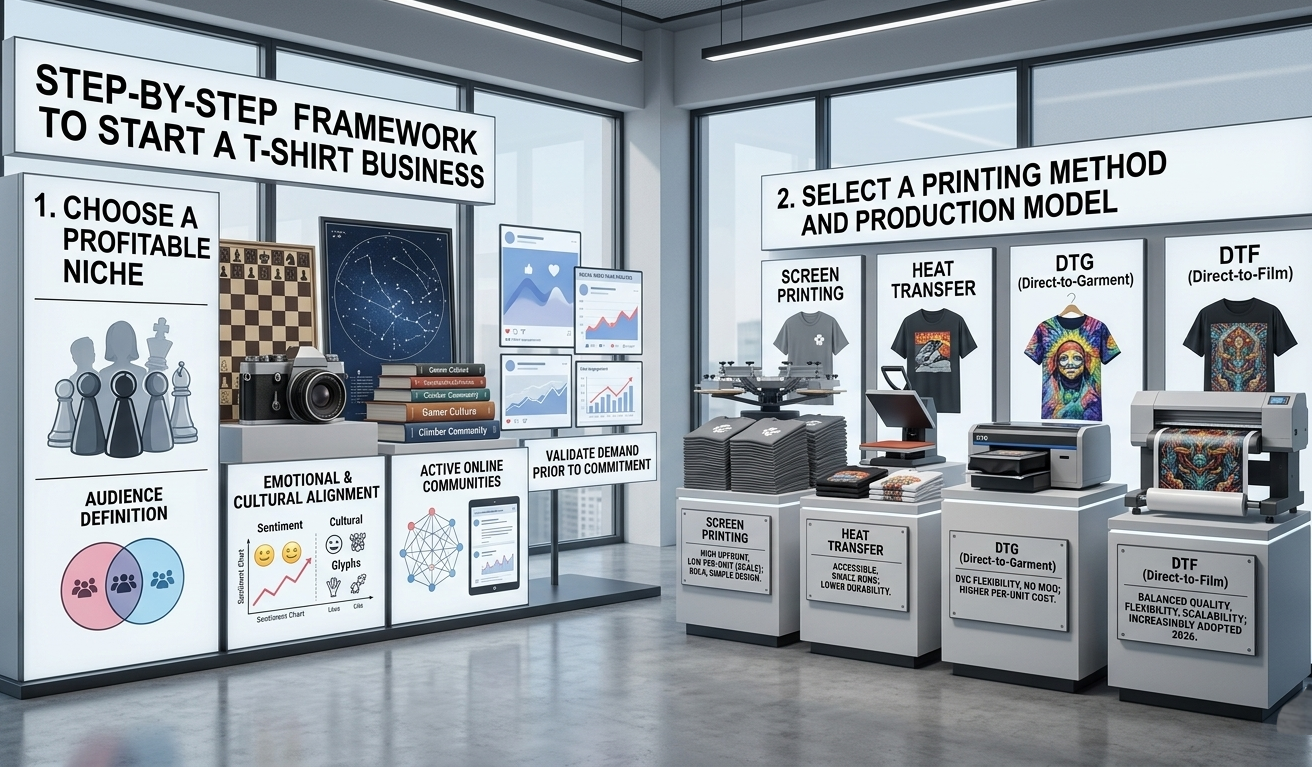
Step-by-Step Framework to Start a T-Shirt Business
1. Choose a Profitable Niche
Avoid attempting to sell to a broad audience. Instead, define a clearly identifiable group with shared interests, language, or identity.
Strong niches typically include:
- Clear audience definition
- Emotional or cultural alignment
- Active online communities
Validation should precede commitment. Analyse social platforms, forums, and comment sections to confirm existing demand and engagement.
2. Select a Printing Method and Production Model
Your production approach determines cost structure, scalability, and operational complexity.
Common methods:
- Screen printing
Suitable for bulk production with simple designs. High upfront cost but low per-unit pricing at scale. - Heat transfer
Accessible for small runs. Lower durability over time. - DTG (Direct-to-Garment)
Widely used in print-on-demand. No minimum order quantity; higher per-unit cost but maximum flexibility. - DTF (Direct-to-Film)
Increasingly adopted in 2026. Balances quality, flexibility, and scalability.
For most beginners, print-on-demand with DTG is the lowest-risk entry point.
3. Create High-Converting Designs
Design quality is the primary differentiator. Effective designs communicate instantly and align with the target audience’s identity.
Core principles:
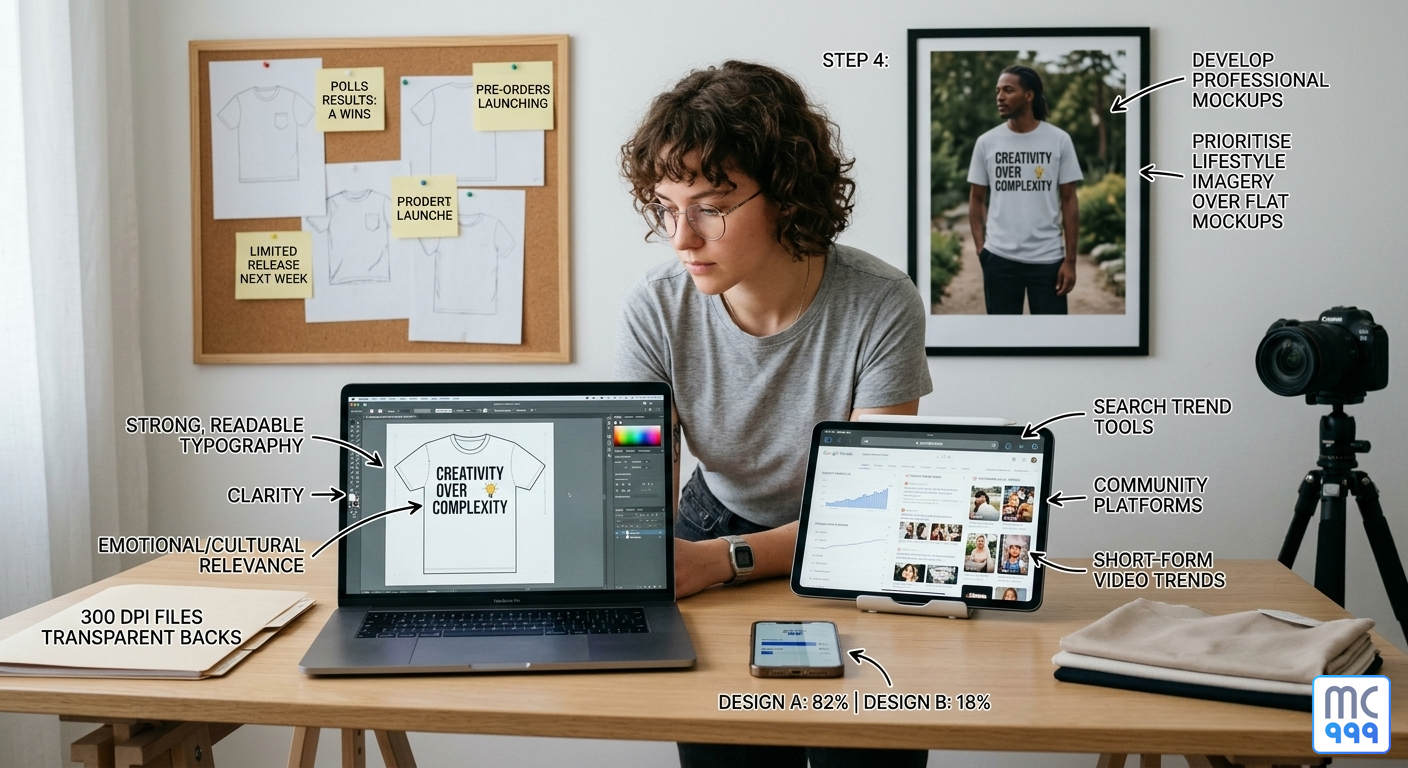
- Clarity over complexity
- Strong, readable typography
- Emotional or cultural relevance
Research and Validation
Use:
- Search trend tools for demand signals
- Community platforms for language and humour
- Short-form video platforms for visual trends
Validation methods include polls, pre-orders, or limited releases.
4. Develop Professional Mockups
Presentation directly affects perceived value.
Best practices:
- Use 300 DPI files with transparent backgrounds
- Prioritise lifestyle imagery over flat mockups
- Maintain consistent visual branding across products
Customers respond more positively to realistic product context.

5. Validate Before Scaling
Avoid premature inventory investment.
Effective validation methods:
- Social media engagement
- Email list feedback
- Pre-orders or crowdfunding
Confirmed willingness to pay is the only reliable validation metric.
6. Establish Legal and Pricing Foundations
Business Structure
Operate under an appropriate structure (e.g. sole trader or limited company) depending on jurisdiction. Address tax obligations and compliance early to prevent scaling constraints.
Pricing Strategy
- Cost-plus pricing: fixed margin over costs
- Keystone pricing: standard retail doubling
- Value-based pricing: aligned with brand perception
Value-based pricing dominates in apparel due to identity-driven purchasing behaviour.
7. Build Your Online Store
Your store functions as the central asset of the business.
Platform Selection
Many brands begin with Shopify due to its ease of use and ecosystem. However, reliance on a single platform introduces risk.

Featuring Mc999
Mc999 represents a different infrastructure model focused on seller control and independence.
Key characteristics:
- No payment processing—transactions occur directly between buyer and seller
- No platform-imposed restrictions on listings or communication
- Integration with existing ecommerce platforms
- Direct ownership of customer relationships
Its Shop-Hub, Flea Market, and Services structure enables multi-channel discovery without limiting operational control. This is particularly relevant for brands seeking long-term autonomy rather than dependency on centralised marketplaces.
Marketing and Scaling
Organic and Community-Led Growth
Short-form video and visual platforms dominate discovery. Authentic, user-focused content consistently outperforms highly produced advertising.
Micro-influencers often deliver stronger conversion rates due to audience trust and specificity.
Paid Advertising
Paid channels remain effective when used strategically:
- Test multiple creatives
- Track return on ad spend (ROAS)
- Use retargeting to capture non-converting traffic
Email and Retention
Email marketing remains one of the highest ROI channels. Early list-building is essential.
Repeat customers significantly reduce acquisition costs and stabilise revenue.
Common Mistakes
Frequent errors include:
- Skipping validation
- Underpricing products
- Over-reliance on a single platform
- Generic or low-quality designs
- Weak brand identity
Structural weaknesses at early stages limit long-term scalability.
Final Perspective
A t-shirt business in 2026 is not simply a product venture; it is a brand-building exercise. Sustainable success depends on ownership—of audience, distribution, and operations.
Platforms that prioritise independence, such as Mc999, align more closely with long-term brand control than traditional marketplace models.
Execution quality—not entry difficulty—determines outcomes.
FAQ
How much does it cost to start a t-shirt business in 2026?
Costs vary, but many founders begin with a few hundred pounds using print-on-demand and organic marketing.
Is a t-shirt business still profitable?
Yes. With strong niche positioning and direct-to-consumer strategy, margins remain competitive.
What is the best printing method for beginners?
DTG and print-on-demand offer the lowest upfront risk and highest flexibility.
Can I start without holding inventory?
Yes. Print-on-demand models eliminate the need for stock.
What is the best platform to sell t-shirts online?
It depends on objectives. Shopify offers simplicity, while Mc999 provides greater control, multichannel exposure, and operational independence.